TSUKUBA, Japan, Apr 22, 2026 - (ACN Newswire) - Discovering and characterizing new materials is important for unlocking advances in fields like clean energy, advanced manufacturing, and improved infrastructure. Researchers use machine learning and other computational tools to help them, but the trial-and-error nature of the process creates specific challenges. The research produces large amounts of experimental and computational data, and scientists need tools that can track and store not only the results but also the chain of reasoning behind them.

A new system called pinax, published in the journal Science and Technology of Advanced Materials: Methods, provides precisely those features. Developed by engineers at Japan’s National Institute for Materials Science (NIMS), pinax captures the entire process of developing new materials, including machine learning workflows and decision-making processes. “By formalizing both successful and unsuccessful trial-and-error processes, pinax enhances reproducibility, accountability, and knowledge sharing while maintaining strict data governance,” says Satoshi Minamoto of NIMS, the study’s lead author.
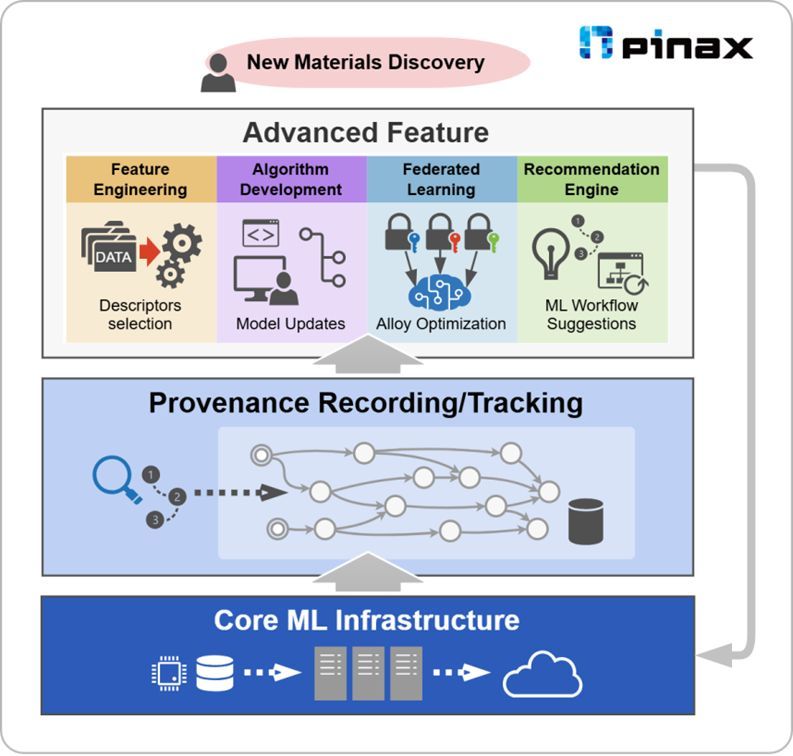
Machine learning models are playing an ever-larger role in materials discovery and characterization. While the models are powerful tools, the reasoning processes they use are generally opaque. Researchers don’t know what considerations and trial-and-error processes went into their final predictions. “The system introduced in this study visualizes these invisible processes. This enables others to review, verify, and build upon the path to the conclusions,” says Minamoto.
Minamoto highlights the importance of such access in applications where safety, reproducibility, and accountability are important, saying that this work “demonstrates how transparent AI systems can transform scientific discovery into a more reliable, efficient, and socially responsible endeavor.”
The team tested pinax using two case studies: one on predicting steel properties and another using transfer learning to predict the thermal conductivity of polymers. The system made it possible to link the model’s performance predictions to the specific data or model aspects that influenced them, and to reproduce complex, multi-stage workflows. “In particular, the transfer-learning example highlights pinax’s ability to track how information flows between intertwined datasets and models, making every step in the reasoning process explicitly traceable,” says Minamoto.
The engineers plan to expand pinax towards an autonomous, closed-loop materials discovery system. By integrating pinax’s tracking capabilities with automated experimental and simulation systems, they aim to create a loop that can use data generation, machine learning models, and decision-making systems to systematically and independently carry out the entire research cycle.
Further information
Satoshi Minamoto
National Institute for Materials Science
minamoto.satoshi@nims.go.jp
Paper: https://doi.org/10.1080/27660400.2026.2629051
About Science and Technology of Advanced Materials: Methods (STAM-M)
STAM Methods is an open access sister journal of Science and Technology of Advanced Materials (STAM), and focuses on emergent methods and tools for improving and/or accelerating materials developments, such as methodology, apparatus, instrumentation, modeling, high-through put data collection, materials/process informatics, databases, and programming. https://www.tandfonline.com/STAM-M
Dr Kazuya Saito
STAM Methods Publishing Director
SAITO.Kazuya@nims.go.jp
Press release distributed by Asia Research News for Science and Technology of Advanced Materials.
Copyright 2026 ACN Newswire. All rights reserved. www.acnnewswire.com